Grant Programs: From Beloved to Scapegoat
Originally published on X, January 2025
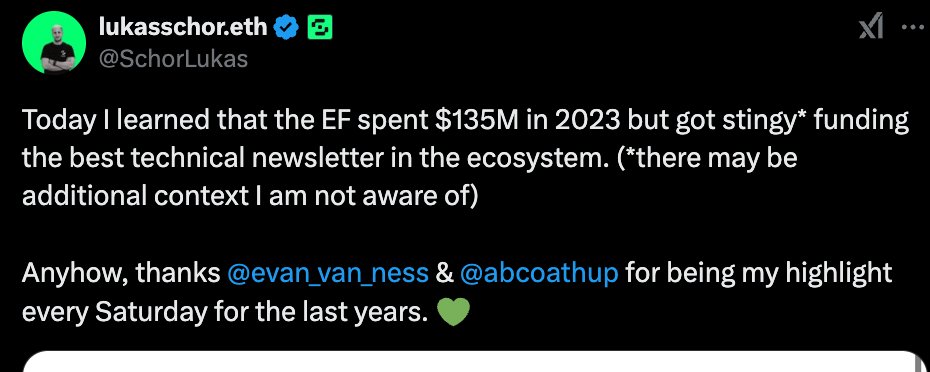
On (*there may be additional context I am not aware of)
What motivated the EF to fund a particular grant? Why didn’t the EF support a particular grant?
These are questions that seem to be asked frequently about the EF and other grant programs. To help set the conversation, let’s look at why this happens and what different ecosystems are doing about it.
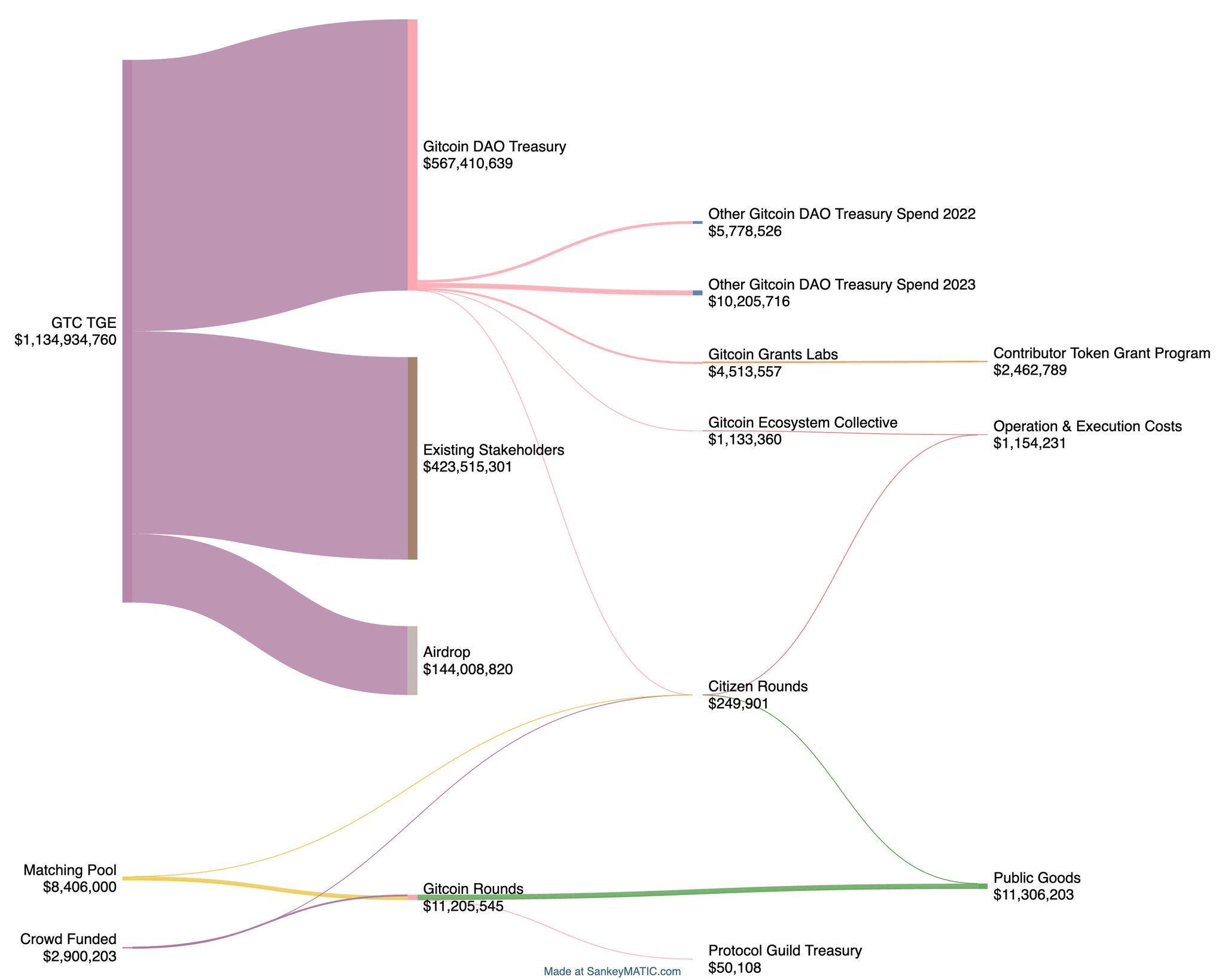
Sankey charts are used to show how different ecosystems have provided funding to:
- Ecosystem Growth - mainly traditionally ecosystem grant programs where the goal of the funding is growth within their respective ecosystem
- Public Goods
- Operation & Execution Costs - incurred by each program
- Foundation Expenses
Flows outside these categories and some older flow may not be captured. The figures are from information that is publicly available. Values are based on the value at the time the capital was distributed.
First, let’s look at how grants have typically been distributed in crypto.
Ecosystems either vote to approve a grant or a grant program is started by a group such as a Foundation. The latter is made up of individuals tasked with distributing a pool of capital to teams building in or contributing to the ecosystem. These programs usually begin with excitement and support from the community: the ecosystem is new, the treasury is large, and people are eager to contribute.
This was the hype that pulled me towards @AaveGrants in June 2021:
- The Aave protocol had been decentralized to the community earlier that year with the establishment of the Aave DAO,
- The community of token holders suddenly had access to a huge capital pool through the Aave Ecosystem Reserve, and
- What seemed like the whole crypto community at the time was rallying behind them.
I had just quit my job at a bank and was ready to make the jump full-time into crypto – the last roadblock was that I didn’t have a job lined up. I took the, potentially naïve advice, that contributions in crypto would be rewarded and “just started contributing to different ecosystems.”
My tenure at the bank was not long enough to believe their ‘blockchain not Bitcoin’ narrative, but I was there long enough to believe that borrowing and lending was at the core of any financial system. Presuming that if this “DeFi thing” were to take off borrowing and lending protocols would play a key role, working with the best team in the space became my dream job.
Looking for opportunities to contribute, I listened to and shared notes summarizing the first Aave Grants community call. That simple decision started the snowball that would turn my dream into a reality. After sharing the notes, I was asked to join the team where my role grew until I took over as the lead in December 2023.
More on this another time though - let’s get back to understanding these grant programs.
While the dynamics and mandates can vary between different programs, the key similarity between these programs is that, at their core, they rely on some form of discretionary decision-making to decide which proposals to fund and which to reject.
This proposition makes sense on the surface: ecosystems give power to a group of individuals who can:
- Act more quickly than and reduce the load on alternative funding routes, usually a proposal directly to the DAO.
- Use their expertise and judgment to cut through the noise and make decisions that best benefit the ecosystem.
These programs work to maintain their legitimacy and support within the particular community by providing transparency and placing well-respected individuals in charge of the capital allocation decision. Transparency provides everyone an understanding of the process, how capital was allocated, and its impact.
Having the right people in charge is key to maintaining the community’s trust and support for future proposals. Programs will establish this trust by appointing well-known individuals who are recognized as knowledgeable, have a high level of integrity, and are capable of making impactful grant decisions.
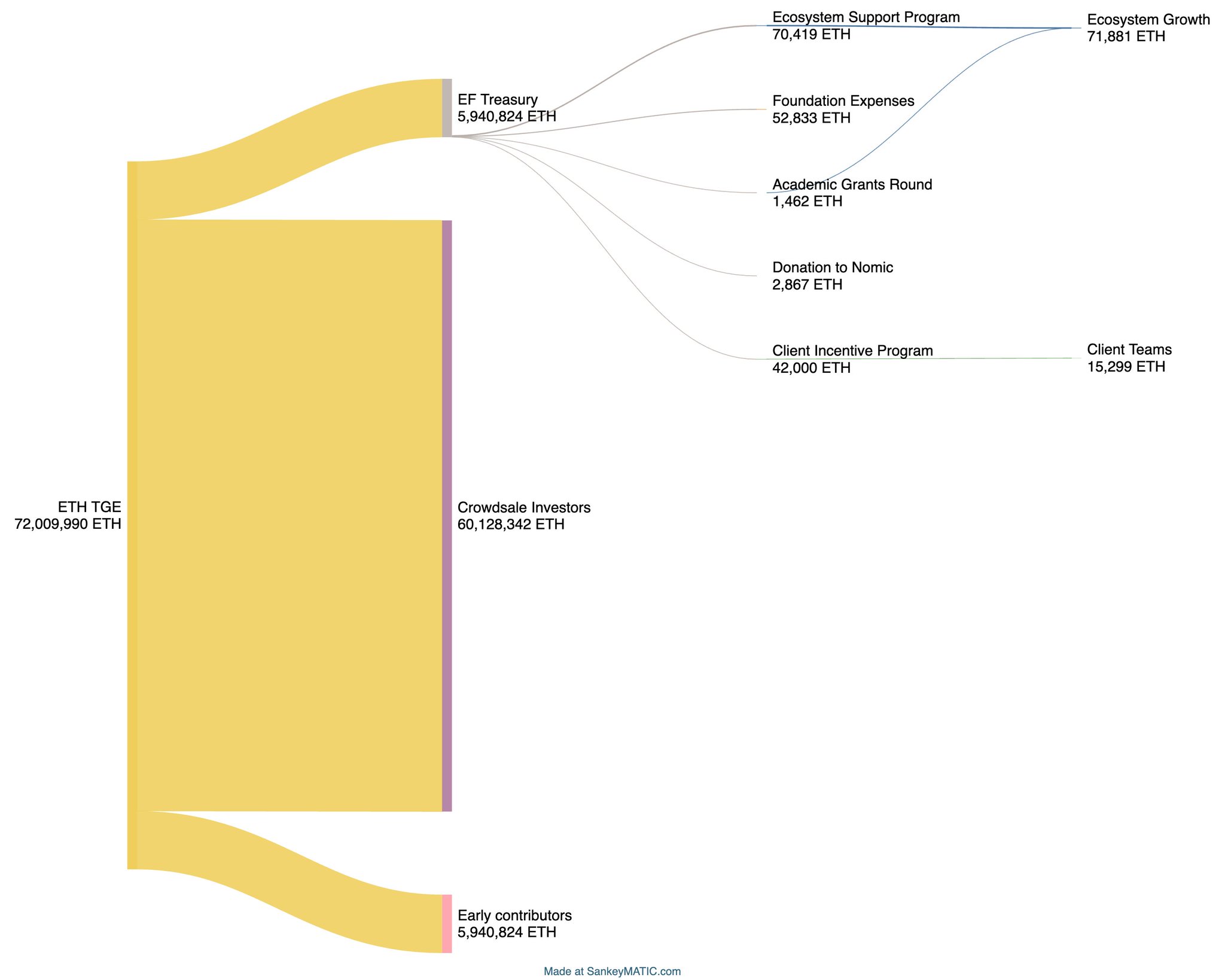
The majority of capital that the EF distributes is through the Ecosystem Support Program. The EF makes the capital allocation decision and provides the community with quarterly grant updates and an annual financial report.
EF Treasury Flows (*denominated in ETH)
Additional context people may not be aware of
Discretionary committees run into criticism because there may be (or usually is) additional context people may not be aware of.
For starters, everyone’s opinions are different. Discretionary committees rely on *opinions* - not everyone is going to see things the same way or have the same perspective. As programs expand and the number of funded proposals increases, the opportunity for disagreement grows. After hundreds of decisions have been made, there will certainly be people who can point to decisions they disagree with.
Most people are willing to accept that not every funding decision will align with their views. People understand that the goal is not for the council to make the same funding decisions that they themselves would make in the position but to make funding decisions that best achieve the objective of the program. If people can understand the funding decision and see it as aligned with the ecosystem, then the program can maintain its legitimacy even if they would have made a different decision. In this sense, alignment means that all the stakeholders in the network agree on:
- The protocol goal
- How to measure progress towards the goal
- How to achieve the goal
What individuals cannot accept, and what usually occurs when these discussions spillover from the governance forum into X, is when decisions are made that an individual does not agree with and do not seem to be aligned with the ecosystem.
From the EF’s perspective then, we can assume the Week in Ethereum (WiE) either no longer achieved the goal of the protocol or the approach was not the best way to achieve their goal.
If a program continues to make decisions that stakeholders disagree with and do not provide a rationale that the community can understand, the community will begin to question the program’s legitimacy.
The issue is that with the proper context, the decision might actually be aligned with the ecosystem and its values. Maybe the EF’s goals changed and WiE is no longer the type of project they want to fund. Or maybe the EF has identified a better way to achieve the goal. However, unless the context is publicly shared and understood, the community is now being asked to trust a committee to make decisions that they do not agree with.
The answer is not as simple as reducing any type of human judgement or input that is used in the allocation decision. Ecosystems benefit from having individuals leverage their subjective views and knowledge to make the best decision possible. The question with discretionary committees becomes, how can a community verify whether the individuals making the allocation decisions are using the power given to them to actually make better grant decisions, as opposed to using the power given to them to benefit themselves or express their bias.
What have communities done to try and address this?
Elections. To increase diversity amongst committees, some ecosystems have held elections for review members, directly encouraging community members to join the committee and to participate in choosing who is on the council. While the intention of holding elections for reviewers makes sense, it is only as effective as the decision mechanism holding the election. For example, if the election is based on a token vote, it can face questions around concentration of voting power or limited interest from the community.
Rubrics. Instead of relying on an individual’s subjective opinion, some programs have implemented more structure to the review process with tools such as rubrics. This helps to align stakeholders in the ecosystem on how the goal will be measured. By adding structure to the review process, evaluations can be more easily understood and there is less opportunity for reviewers to inject any bias. Or if they do, it becomes easier for the community to audit, question, and call out any seemingly misaligned decisions. Rubrics have to carefully balance the flexibility given to reviewers - too little flexibility and reviewers may not be able to support applications that turn out to be valuable, but don’t score well on the rubric for whatever reason. It can be hard for rubrics to capture the potential of grants that could be zero-to-one game-changers. This is better captured by a reviewer’s subjective input. If rubrics give reviewers too much flexibility though, similar questions around trust and bias can arise.
RFPs. To align stakeholders on the goal of funding, some ecosystems have defined the scope and goals of how the capital should be allocated. If the goal of the funding can be better defined beyond something general, like “increase ecosystem growth”, the community can better understand how the committee is assessing grant proposals. While RFP’s help to define the goal of funding and can even include evaluation criteria , RFP’s can still leave room for reviewers to insert their bias and rely on the larger community to audit and hold the grant committee accountable.
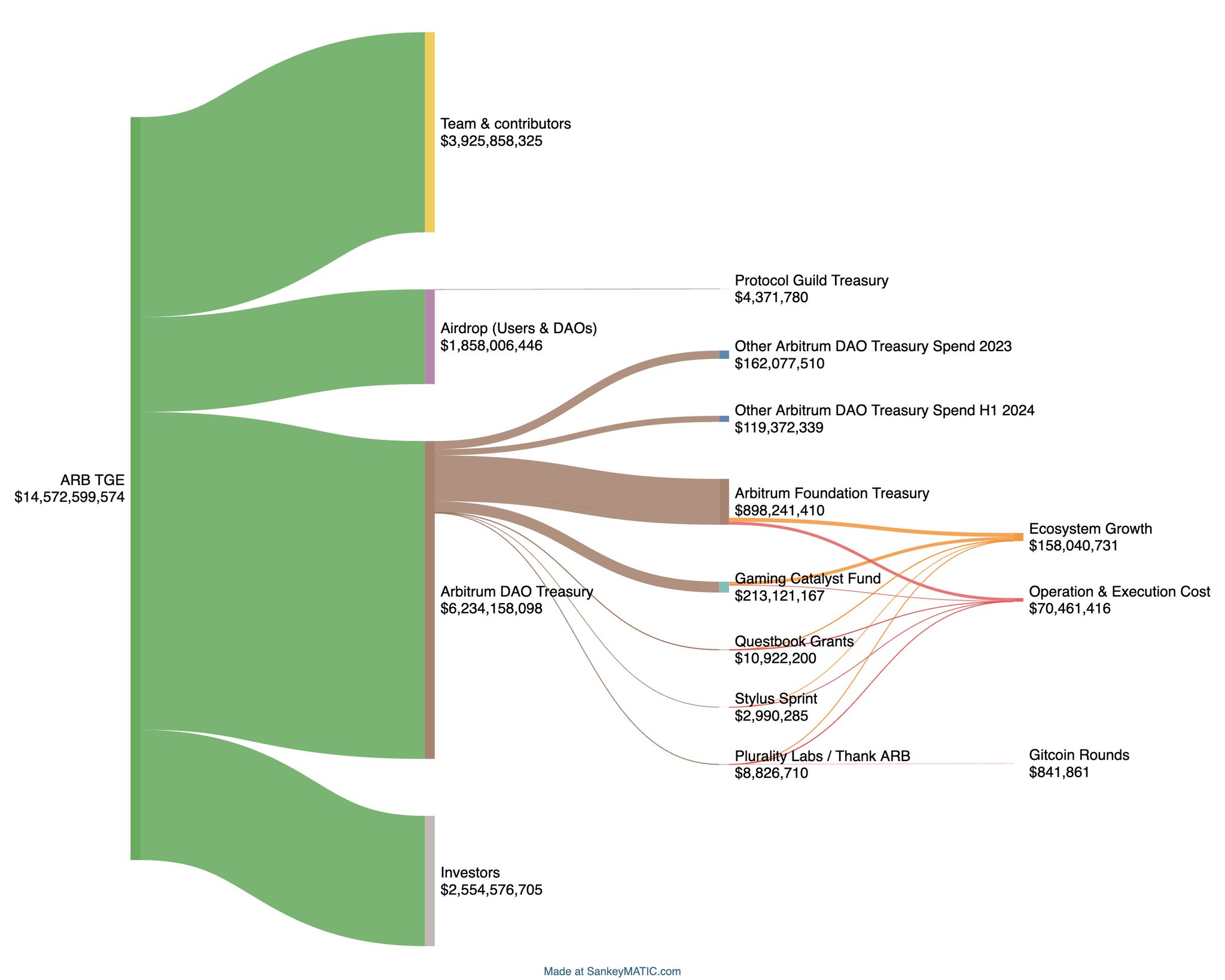
Multiple programs. Some ecosystems have run multiple grant programs with different set ups to reduce the potential of corruption from any one bad actor and give the community more choice in evaluating which programs to trust and move forward with. For example, the Arbitrum DAO has funded multiple grant programs directly, including a meta-grant program that funded 12 different grant programs. While it is positive to give the community choice and to allow for experimentation with new mechanisms, it is dependent on one of these experiments winning out. Having numerous discretionary committees does not solve the problem.
Arbitrum DAO Treasury Flows
Alternative mechanisms. The other approach communities have taken is to experiment with the allocation mechanism itself. Instead of using a discretionary committee to make the grant allocation decision, some ecosystems have adopted other allocation mechanisms, for example, Gitcoin’s Quadratic Funding (QF). This removes any discretionary aspect from the funding - both the negative but also the benefit gained if the input provided is high quality and leads to better outcomes. QF allocates funds collected from various ecosystems known as a Matching Pool. The matching pool is allocated based on a formula that gives greater weight to the number of individual donors a proposal has over the amount of capital donated. QF is an improvement on standard token-voting where power can be concentrated. Large amounts of capital have a muted impact while the impact of smaller donations can be amplified.
Gitcoin Ecosystem Flows
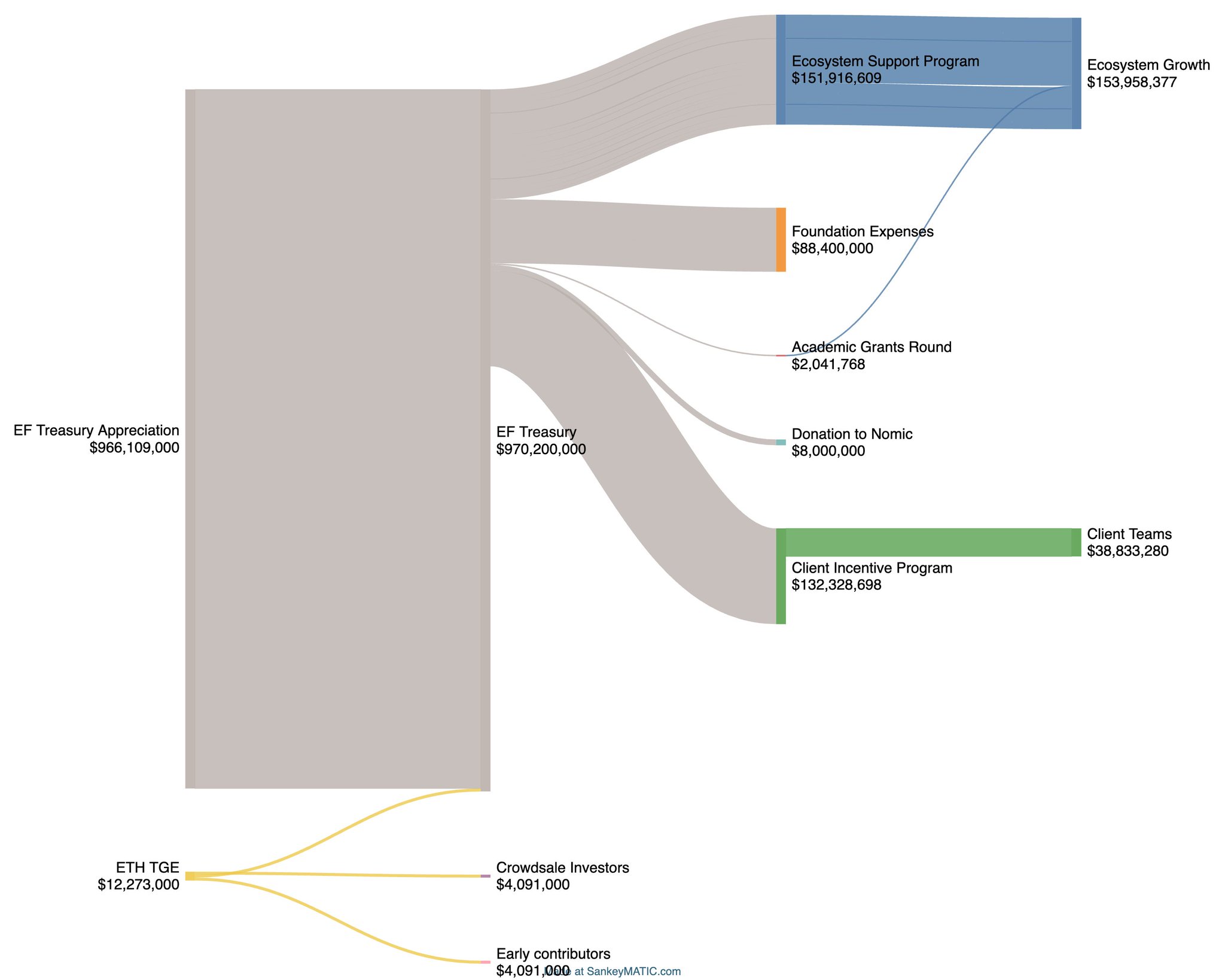
Bonus Sankey if you read to the end! Here is the Sankey for the EF denominated in dollars, with an inflow of ‘EF Treasury Appreciation’ based on data provided in the EF’s 2024 report which is as of October 31, 2024.
Say whatever you want about the EF but the decision to bet on themselves and the ecosystem by holding a majority of their assets in ETH was clearly a winning strategy.